Copper tariffs
If you wanted to stimulate US copper production with a fiscal intervention, it would be cheaper to subsidize the entire cost of using US-origin copper in distribution transformers funded by a 14¢/MWh (wholesale, ≈0.3%) tax on new capacity than to impose a 50% increase in copper costs through tariffs.[1] The problem with expensive copper is that we use less of it, pushing costs to the future.
A common refrain is that taxes on inputs to a manufacturing process – like tariffs on copper – disadvantage the manufacturer and user of the end good more than they advantage the preferred producer. Evaluating how true this is requires some quantification of the relationship between the price of the inputs, the price of the outputs, and the utility of the goods. Across all the goods that use the 1.6 million tons of copper consumed in the US every year, that relationship might be too fuzzy to calculate.
The market of small distribution transformers, though, is more transparent: buyers request and manufacturers make cost-optimizing choices that balance somewhat real-time commodity costs with the operating costs incurred on the buyer, which are several times the purchase cost and scale up or down in largest part with how much copper the transformer uses. When wiring in buildings or vehicles where you will always install a particular gauge of wire for a particular load, your propensity to install or buy it may depend on the price: a fixed good with elastic demand.
The demand for a transformer of a given capacity is basically inelastic: unlike in buildings or vehicles, a required transformer will be installed but will use less copper and be less efficient if purchased when copper is more expensive.
Transmission factor β
How much? Consider β: for a given proportion of change in copper cost, how much of that change is transmitted as an increase in the various costs of the final good? We sampled our transformer optimal design tool and cost model across a few thousand designs and copper cost points relative to the present cost around $12,000/mt and evaluated these β derivatives, which are essentially constant across a wide range of possible cost increments:[2]
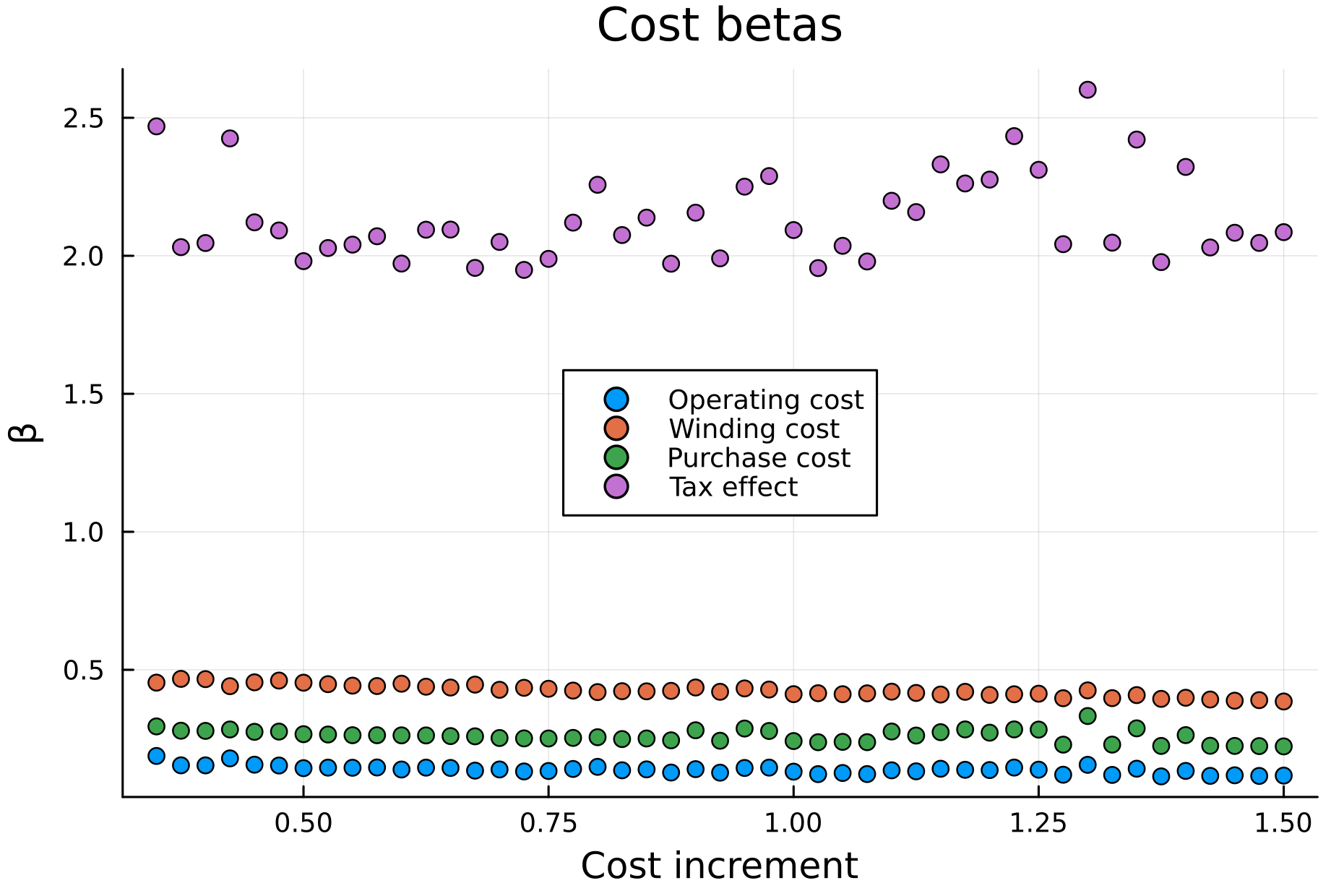
The β is about 0.45. For a 50% increment in cost, 0.45 × 50% is passed on: the winding gets about 22% more expensive than before. It is a smaller, more lossy winding! For one of the 100 kVA transformers we evaluated here, a 50% increment in copper costs takes the winding from $790 to $970.
For the other major commodity component, the core, β ≈ 0. A smaller winding needs less core. The cost of a core made of high efficiency, low-saturation material that increases the winding size is similarly insensitive to changes in copper cost but results in more punishing transmission of winding costs. Overall, β for purchase cost is 0.260 ± 0.023: a ≈10% increase for a 50% increase in apparent copper prices.
Operating costs have the smallest β: 0.138 ± 0.015. This hides the scale of operating costs: for the same 100 kVA transformer at a 50% copper tariff, they go from $8930 to $9570 net present dollars over its 30 year life. The $640 in additional operating costs, at wholesale electricity prices, is pure waste: 13,000 kWh lost as heat.
The ratio between that $640 in waste and the $320 collected in tariff on the original copper is depicted in purple as the “Tax effect”, approximately 2. Out of the additional $980 cost incurred by the 50% tariff, only
is collected. The full $980 in costs incurred on electricity consumers would pay for the baseline $790 in US-origin copper, and plenty more.
| [1] | This is a notable caveat: I can't make a claim about what the transmission of copper tariffs into domestic copper prices actually will be. |
| [2] | The uncertainty in these traces arises from hitting different minima or constraints in the transformer design space, and so uncertainty associated with each β should be read as about 15% (relative). |